LEYENDAS DEL PATINAJE BRITÁNICO

Henry Crystall
Henry Crystall was born at 51 Virginia Road, Bethnal Green, the second of three children on 15th May 1916. His father, Solomon, was a Russian immigrant born in Riga, Latvia who came to Britain in 1890 as a child and owned a fish and chip shop in St. John’s Road (now Pitfield Street), Hoxton. His mother, Yetta, was also an immigrant born in Romania.
In 1935 aged nineteen Crystall donned a pair of roller skates for the very first time at the Forest Gate rink. It was a bit of a novelty for him at first but he soon got the bug.

In 1937 the family moved to Brownlow Road in Wood Green where his father was now a gents barber. It was whilst living here with his parents that Crystall got himself a job as a tailor’s cutter and found himself continuing to enjoy roller skating just a few miles away at the Alexandra Palace. He felt so at home on eight wheels that he started to practice roller dancing as well as becoming a very proficient hockey player, but his first love was always speed skating. He joined the Alexandra Palace club and almost immediately started racing. He got a few handicap medals under his belt and then on 3rd March 1938 Crystall secured a bronze medal in the half mile Seagrave Cup handicap.
A little over a month later Great Britain hosted the first ever world track championships (although originally billed as a European championships) at the Empire Pool, Wembley. It was still relatively early on in Crystall’s racing career and by his own admission he was nowhere near the level of the likes of his Alexandra Palace teammates Bill Ross or Jimmy Reed and so he offered his services to the National Skating Association to help run the event. He was given the task of operating the lap board and in so doing found himself on the inside of a track for the very first time.

In 1939 he took and achieved his NSA gold speed test but very soon afterwards war broke out which pretty much halted any progress he was making with his speed skating abilities. Whilst still employed as a tailor’s cutter he also undertook a role for the civil defence as an ARP ambulance driver. Despite the war going on there were still the occasional races, although entries were understandably very poor. On 15th March 1945 he managed a silver medal in a half mile scratch race behind his teammate Harding. It would be his last competitive medal.
Almost immediately after the war had finished and now nearing his 30th birthday Crystall realised that he was always going to be an also-ran amongst Britain’s speed skating fraternity. Racing was also still very sporadic as the country started to rebuild itself. He had always taken a keen interest in administrative activities, now holding the position of Honorary Secretary and Treasurer for the Alexandra Palace club, but after having a taste of what it felt like to ‘stand in the middle’ Crystall decided that his future lay not with racing, but to help administer the sport in general. Despite this, on October 20th, 1945, he took part in race and attempt to lower the British half mile record along with four other Alexandra Palace skaters, one of whom was 1939 British Five Mile championship medallist, Stan ‘Jimmy’ Hartigan. Crystall led for six of the eight laps but Hartigan took over with two to go and crossed the line first. Whilst the record attempt was unsuccessful it was commentated on by Stuart McPherson, live on the BBC radio.
By early 1946 Crystall had become a member of the Roller Speed Committee. He had his first taste of officialdom, if we exclude his lap board exploits in 1938, on 21st March when he was assigned the role of Track Steward for the One Mile British championship at Alexandra Palace. Although now an official he did also continue to race for a period even making the semi-finals of the Half Mile British championship a month later on 20th April. Pretty much coinciding with his 30th birthday, however, Crystall decided to hang up his racing boots for good.

By 1950 he was now the Assistant Hon. Secretary of the Roller Speed Committee as well as the roller speed representative on the NSA Council. Crystall really was making a name for himself as a significant member of the sport’s governing body and it wasn’t long before he was called upon to act as referee at numerous race meetings. He was also an official National Roller Hockey Association (NRHA) referee as well as coaching the Alexandra Palace ladies team to some degree of success.

In 1952 the Roller Speed Committee were donated a trophy, the Chambers Trophy, to be used for an inter-club competition. The Roller Speed Committee set up a special sub-committee to determine how the event should be run of which Crystall was invited to be part of. On 13th May the Alexandra Palace club became the first recipients of this coveted trophy, helped in no small part by the ladies section which Crystall proudly coached. That same year he was accepted by the world governing body, the Federation International de Patinage a Roulettes (FIPR), to be an international judge. Over the years he would officiate and even referee on occasion at many world and European championships.

Through his involvement with roller hockey Crystall struck up a friendship with Cyril Beastall, editor and owner of the popular ‘Roller Skating’ magazine. Over the years he would contribute articles and race reports predominantly surrounding major international competitions. One such report featured the controversial events surrounding the 1960 world championships in Wetteren, Belgium. Controversy that Crystall was firmly at the centre of.
Crystall was a finishing judge at those championships but when Leo Eason was declassified from first place to last place for an infringement on the last bend in the 5000 metres, Crystall was less than impressed and made it known. There were already several obvious errors with the declared finishing places of some of the athletes and being one of four finishing judges Crystall felt that the calibre of his FIRS (formerly FIPR) officiating colleagues was distinctly lacking. Worse, his protestations appeared to fall on deaf ears. The final straw came when in the ladies 500 meters knock-out competition an error meant that the bell for the last lap was rung at the wrong point in a round featuring British skater Barbara Woodley. Woodley had crossed the line ahead of her German adversary, Helga Schoeps, to complete the distance when the bell rang for another lap. In the ensuing confusion the German girl completed the next lap ahead of Woodley. Naturally, the British contingent, and especially Crystall, were up in arms. The officials suggested that the race be rerun but an aggrieved Woodley refused believing that she should advance to the next round. What she, or anybody else for that matter, didn’t expect was what happened next.

Crystall, enraged at what he saw as an obvious injustice, conversed with his friend and British team manager, Bert Lamb, and together they agreed to withdraw the entire British team from further competition. This is how the event was noted in the Roller Speed Committee report of 1960:
"The occasion was a most unsatisfactory one for the British party of competitors and Officials, and in several instances there were deficiencies in organisation and which, when brought to notice, were not rectified.........Added to the many incidences of mismanagement and wrong decisions to which attention was drawn, Mr.Lamb felt obliged to withdraw the British team from its engagement, action which had the approval of the British skaters and several other experienced speed skaters from this country".
Despite the contents of the report, it is understood that none of the team were actually consulted and the general feeling was that although an unsatisfactory situation, this was an unwarranted overreaction. Regardless, on Crystall and Lamb’s say-so the championships continued without British inclusion.
To make matters worse for British athletes, the 1961 world road championships in Gujan-Mestras, France and the world track championships in Voltrega, Spain were also boycotted by Great Britain. This is how the Roller Speed Committee commented on the matter in their report for 1961:
"Two International events in Roller Speed Skating....took place during the past season for which no British skaters were entered in sustantiation of the Roller Speed Committee's view strongly held, of the deficiencies in the organisation of the World Championships held on road in Belgium in 1960, and as referred to in the previous year's Report".
In later years many of those that had been selected or were eligible for the British team at that time were asked about those events. The likes of Pat and Leo Eason and Les Woodley were less than kind to what they felt was Crystall and Lamb’s pomposity and own self-importance. Britain were certainly a force to be reckoned with at that time with many of its skaters achieving medals on the biggest of stages. It was certainly within the realms of possibility that a British skater could have become a world champion had they been allowed to compete.
After some sixteen years on the Roller Speed Committee, in 1962 Crystall was finally elected as Chairman, a position he would hold on three separate occasions over the next fifteen years. In the same year he was also made the British team manager for the first time, again another position he would undertake on various occasions for the next eighteen years.
He would continue to write articles for Cyril Beastall right up until the magazine publication ceased in 1969. His writing prowess wasn’t just limited to ‘Roller Skating’ magazine, however. In early 1964 he also penned a 5-part series called "Get Your Skates On!" in Boys' World.

Crystall continued to rub shoulders with the sport’s global administrative elite. He was by now a well-known figure internationally and regularly attended FIRS congress meetings abroad as a representative of the NSA and roller speed skating. By the mid-1970’s he was formally recognised by the Federation International de Roller Skating (FIRS) and made a commissioner of the organisation. This was not a role that was undertaken lightly as FIRS was now recognised by the International Olympic Committee (IOC) and all efforts were on securing a roller skating discipline at the Olympic table.
People say that lightning doesn’t strike twice but in the 1978 European championships in La Roche, France, another dubious refereeing decision resulted in yet another withdrawal of the British team. It centred on another knock-out competition, this time between great rivals John Fry senior and sprint legend Giuseppe Cantarella (Italy). Exiting the last bend the two skaters came together. Fry had already taken gold in the time trial and to most people watching, including many of the officials, it was apparent that the clash was caused by the Italian. Four officials made notes to disqualify Cantarella but the Judge Arbitre (Chief Referee) overruled the officials and disqualified Fry. Crystall was again at the centre of the ensuing argument. Despite protestations the decision was not reversed. Crystall and Tony Wordsworth (team manager) conversed and withdrew the British team from further competition. Unlike 1960, however, this was the last event. Fry, McGeough and Mullane had all won gold medals up to this point and the last event was ‘on’ for the fourth member of the team, Tom Bartlett. With four British skaters in the last eight there was a very good chance that Bartlett could have secured his own victory, but that outcome will always now be regarded as a ‘what if?’.
Two years later in 1980 and having given so much to the sport Crystall resigned his position on the Roller Speed Committee. He had been a mainstay and central figure for almost 40 years and now it was time for some new blood.
In 1981 the National Skating Association recognised Crystall’s distinguished services to roller skating and bestowed upon him an Honorary Membership. Only a handful of people had been selected for that honour since the Association’s formation in 1879 and it was a fitting tribute for his years of dedication.
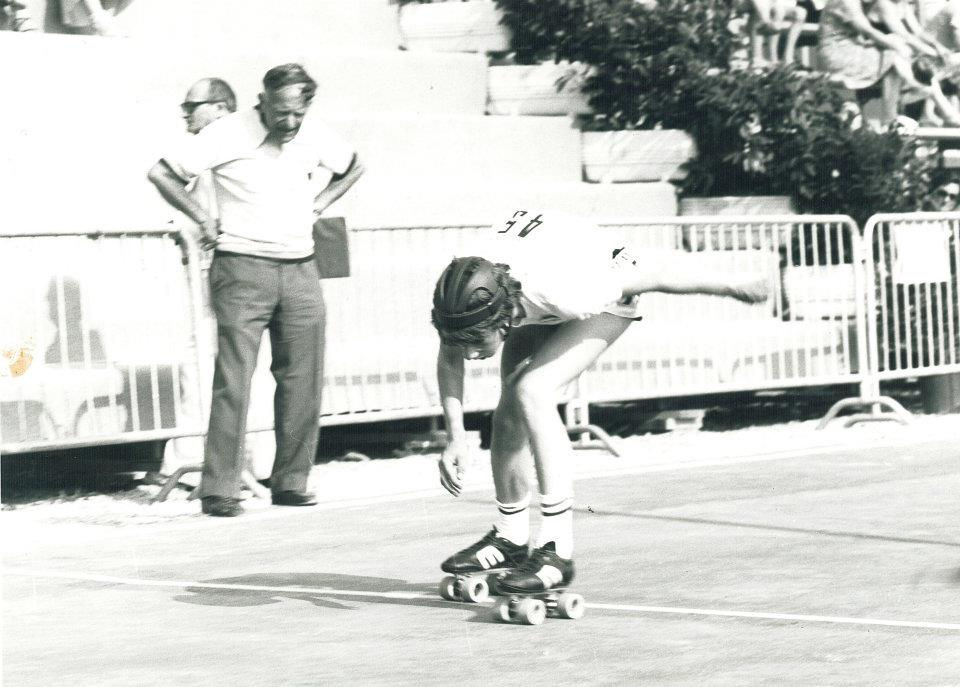
Unlike many, however, he did not walk away entirely from the sport. He continued to officiate on occasion and also commentate on selected races. Some may recall his ‘commentary’ at the 1984 Junior European championships in Birmingham where he read out the names of every single athlete of every single nation during the opening ceremony!
In the 1990s Crystall continued to be active. He became the director of Durnsford Press Ltd. and of the Tottenham Community Sports Centre. He was also a director of Community Action Sport between 1995 and 2004.
I don’t think it is out of turn to suggest that Crystall was considered ‘Marmite’ amongst those who knew him. It is more than evident that he embraced his authority with great enthusiasm which did not always endear him to others either nationally or internationally. Many, especially those who were not aligned to the London clubs, considered him full of his own self-importance, divisive and somewhat partisan when it came to the Alexandra Palace club. But whether one agrees or disagrees with those views, to suggest that was the sum of his parts would be doing him a great injustice.
One must consider that he gave almost 70 years of his life supporting and administering a sport he loved, both nationally and globally for Great Britain. Few others can lay claim to that. Here are just some of those positions he held:
1946-80 Member of the Roller Speed Committee
1949-64, 1968, 1972-77, 1980 Handicapping Board/Gen. Purposes Committee
1950-64, 1969-80 Roller Speed representative on NSA Council
1950-61 Assistant Hon. Sec. – Roller Speed Committee
1958-61 Vice Chairman – Roller Speed Committee
1962-64, 1968-69, 1972-77 Chairman – Roller Speed Committee
1952-80 FIPR/FIRS International Judge
1962-65, 1968, 1980 National Team Manager (Senior)
1975-80 FIRS Commissioner
1980 National Team Manager (Junior)
Crystall held lofty positions in all manner of roller skating governing bodies but whatever people think about his character he was certainly a patriot. He also came from a time when a ‘them and us’ divide was the norm. Part of the old school tie brigade as Les Woodley once put it. But over time his school master attitude would draw its detractors, especially as more liberal attitudes to authority came to the fore in the 1960’s and 70’s.
It should not go unrecognised that Crystall was a stalwart campaigner for sports facilities in the area of Tottenham and Edmonton, especially for children and young people. He was involved with the long-running campaign to save the playing fields at Bull Lane, which ended when Enfield Council agreed to allow partial development of the site for housing. His efforts and standing within the community were rewarded with the naming of a pavilion (the Crystall Pavilion) after him at the Frederick Knight Sports Ground on Willoughby Lane. His name also lives on in the coveted ‘Henry Crystall Trophy’, an annual award in national roller hockey to recognise the sports ‘National Player of the Year’.

Henry Crystall died in early October 2004 aged 88. His influence on roller speed skating should not be underestimated and was certainly felt globally, but none more so than on British shores. Speaking at his funeral, Malcolm Springthorpe, of Community Action Sport, of which Crystall was a trustee commented "I had known him since 1968 and he was one of my main campaigners. He was unique and a real character."
Regardless of how one might view him as a character, Henry Crystall is most definitely a British skating legend.

GB Team Manager of the 1960's and Chairman of the Roller Speed Committee