LEYENDAS DEL PATINAJE BRITÁNICO

Errol Spence
Errol George Spence was born in Northampton on 22nd July 1969. His first foray into roller skating was in the mid 1980’s when he used to frequent the local Roller City rink which, at that time, was being managed by former European champion, John Mullane. During the general sessions Spence would keenly watch the speed skaters whiz around the rink and be in awe of the speed that they could muster, but before he could develop his own speed skills properly the rink closed down.
Spence found himself skating around local car parks, which wasn’t ideal, but wanting to join a club he did his own research and called the offices of the National Skating Association. He explained where he lived and asked if there was a club local to him. The NSA gave Spence the name and number of Brian Hartley who was then coaching the Milton Keynes club. Spence called Hartley who explained that the club trained twice a week at The Agora in Wolverton, Milton Keynes and so in the very early part of 1986 the youngster decided he would make the short train journey (just one stop from Northampton) and go and see what it was all about.
Spence initially travelled with friends but they very quickly lost interest. He turned up to his first training session with the Milton Keynes club in jeans and a sweater and despite getting roared off he was immediately hooked. He trained over the next few months but by the start of the 1986 season he still hadn’t seen a race first hand. Despite this he was encouraged to enter the first race of the season, a 1500 metres handicap on Birmingham Wheels on 4th May. Having been given a handicap of 70 meters Spence went into the race full of confidence but failed to qualify for the final. This was a wake up call for the newbie and on his handicap performance decided not to enter the second event of that day, a 3000 metres scratch race.
Spence’s initial training sessions were all conducted at The Agora indoor rink and the move to outdoors for his very first race was also a shock to his system. Soon afterwards, however, as the weather warmed up training also moved outdoors with the club using the forecourt of the Milton Keynes Central train station, plus the perimeter road of the Milton Keynes Bowl to hone their strength and speed.
Spence’s next race was two weeks later on the track in Westbrook Lane, Herne Bay, over a distance of 500 metres. At that point he didn’t consider himself a tactical skater so preferred the sprints and as coincidence would have it would draw John Mullane in is heat, who had recently come out of retirement after a few years absence from the sport.
1986 was quite a sporadic year for Spence in terms of competition. In fact, he did not enter another race until an Alexandra Palace event in September when he took to the track at Tatem Park for the very first time. Again, his performances were nothing of note as he struggled to adapt to the big sweeping bends of the North London circuit. He again returned home to think about how he could improve and just one week later would find himself on the podium. It was the British Championships on Birmingham Wheels and Spence formed part of the quartet that would bring home the silver medal for Milton Keynes in the relay. Whilst Herne Bay Flyers were the obvious favourites and actually romped home the winners, the Milton Keynes club consisting of Richard Hartley, Brian Hartley, Mark Arthur and of course Spence, surprisingly beat an established Alexandra Palace club by a little over one tenth of a second which made a few people sit up and take note.
At the start of the 1986-87 season Birmingham Wheels held an event on 12th October. Spence again entered and this time would come second behind teammate Mark Arthur to win his first individual medal. Although only a handicap it was evident to many that Spence was starting to improve at a great rate of knots having only been training for less than a year. This was further proved when in the second event, the 5000 metres, Spence would cross the finish line in a remarkable fourth place. Whilst personally he still lacked some confidence in his own abilities, his enjoyment of the sport could not have been more apparent.
In November he entered a two-man relay on the Southend rink with Richard Hartley his teammate. The pair would come second to the Birmingham Wheels duo of John Fry Junior and British international, Ian Ashby. Spence will tell you that it was that result that made him believe that he could go places in the sport and suddenly his newfound confidence began to grow.
Spence would now start to race more regularly throughout the season and his face on the circuit was starting to get some recognition. In July 1987 the British Championship 300 metres time trial on Westbrook Lane was postponed due to timing equipment failure. Favouring shorter distances Spence was left disappointed at the postponement but the 1500 metres event still went ahead. At the end of his heat he found himself in a final sprint against Fry Junior (Birmingham Wheels) and former European Champion, Rohan Harlow (Herne Bay Flyers) on his home track. As the trio crossed the line Spence would finish behind the two skaters but just 5/100ths of a second separated first and third. Whilst he would miss out on a place in the semi-final by just 1/100th of a second he would still leave the track buzzing from the fact that he had given two established skaters a run for their money. A few weeks later and he would return to Herne Bay and put in another sterling performance to secure his first individual scratch medal in a Category 1 3000 metres event behind Ashley Harlow (Herne Bay Flyers) and Ian Ashby (Birmingham Wheels).
Shortly afterwards Spence decided to leave the Milton Keynes club. Some personal differences between himself and some other club members had surfaced on the evening he was supposed to be going to France to race in his first ever international event. He returned home to Northampton that evening, despondent having not gotten further than Milton Keynes and decided in that instant that he would never skate for the Milton Keynes club again.
In September, the British Championship time trial that had been postponed from July was now held on Tatem Park. Skating unattached and in the black and white colours of the NSA Spence would finish second to Ashley Harlow. It was a remarkable sprint performance by someone who had only been racing and training for the best part of eighteen months. Nobody was more surprised than Spence himself. He knew he had quick leg speed and had targeted a top five place, but whilst he was training regularly, he was still not taking it all that seriously. With a British Championship silver medal now hanging around his neck, all that would change.
For the start of the 1988 season Spence decided he needed a new club, but other than Milton Keynes his nearest club was either north up the M1/M6 to Birmingham Wheels or south on the M1 to North London or Alexandra Palace. Neither felt like an attractive prospect so he got together with his friend, Dave Samuels, and restarted the old Northampton club. Samuels had been associated with the earlier Northampton club which had last entered an event in 1985. The old club was run initially by John Mullane but when Roller City closed its doors the club soon ceased to exist. Now, though, with Spence and Samuels keen for it to resurface, the Northampton club once again took to the track. Spence knew Samuels, along with his brother Winston, from the days of Roller City and both saw this as an ideal opportunity to bring skating back to the town.

Despite Spence’s performances the previous year he was initially placed in Category 2 amongst the likes of Chris Ampaduh (Birmingham Wheels) and a young Sutton Atkins (Derby Rollerspeed). Throughout the season the battles between all the skaters in this category were extremely close. In fact, such was the calibre of skaters taking part at that time, Category 2 produced some of the closest and most exciting races of all the categories.
On 16th July at the British Championships, again on Tatem Park, Spence would again bring home a silver medal in the 300 metres time trial behind sprint legend Ashley Harlow (Herne Bay Flyers). Naturally, he still considered himself a sprinter, or certainly a short distance skater, but thought that if a longer distance was slow enough then he could possibly still have the legs at the end to put in a decent performance. That chance came the following day in the 1500 metres. Spence qualified for the final which turned out to be a slow and cagey affair, but as the race built up to a sprint finish, he would secure bronze behind Ashley Harlow and Tony Marriott (North London).
With his ever increasing confidence Spence upped his game further. Training took on a whole new dynamic and longer distances now formed part of his schedule. Graham Burkitt, the father of Northampton skater Vikki Burkitt, gave some much needed structure to the training. Although not a skater himself he not only structured the training sessions but recorded races in order that the club members could rewatch the events and learn from them. At the same time Spence was also a member of a local cycling club and putting in those extra miles on a bike would also pay dividends. By the end of the 1988 season he had firmly established himself as the top Category 2 skater and a regular Category 1 place was now well within his sights.
As 1989 approached Spence was now training hard but Category 1 still eluded him. He upped his training to twice a day with a 4am session, starting work at 6am and then a further 11pm session. Spence was hell bent on mixing it with the top performers, not least of all because one of his main rivals, Sutton Atkins, had now moved up into that elite category. Even Spence’s bronze medals in that years British Championships in the 300 metres time trial and the 500 metres would still not cut it with the powers that be. Asked why he personally thought he was overlooked at that time Spence now thinks that his personal attitude and possible perceived arrogance towards those in charge may have played a large part of his exclusion. Even in 1990 he wasn’t far from controversy, getting himself banned for swearing at the officials and for the first time in a few years he failed to take a medal of any colour in the British Championships. He returned home and thought it was time for some self-reflection.
These days, Spence will tell you he absolutely holds no grudge against those tasked with deciding his skating pathway back then and suggests that he may well have acted the same had he been the one on the receiving end. It is fair to say that he has now matured and mellowed and is more than accepting that he too had a part to play in his own progression. Back in 1991 that became clear to him and from that moment on things would change.
Throughout 1990 Spence had joined a mountain bike racing team which also took him all over the country. Training for both sports was intense and Spence initially chose mountain biking over skating when it came down to priorities. In 1991, however, those priorities switched and whilst he still continued to race on his mountain bike, he decided that his preference was speed skating. Having made his decision, he put more emphasis on his skating career and it paid dividends.
The 1991 season started well with a bronze medal in the 10km Keith Lee Boot, a win in the Seagrave Cup 800 metres handicap and in July he would win two British Championships, the 300 metres time trial and the 1500 metres on Tatem Park. Unusually, the 1500 metres was on the first day of competition and before the time trial. This is how Spence remembers it:
“I knew I was in good condition and firing on all cylinders that weekend but winning the 1500 metres was a real shock to me. In fact, it took weeks, possibly months, for that to really sink in. Even now, when I think about it, I still find it hard to come to terms with”.
What made Spence’s achievement all the more remarkable was that in 1991 the North London club fielded an extremely strong team. Amongst them multiple British Champion and multiple European silver medallist Tony Marriott and former New Zealand international and soon to be European time trial bronze medallist David McFarlane. McFarlane was allowed to compete in the British Championships due to his dual nationality.
The following day was the 300 metres time trial and again Spence was victorious, this time setting a new British Record of 27.16 seconds in the process. (Incidentally, that record still stands today as the fastest time recorded by a British skater on quads). Behind him, in second place, was David McFarlane. McFarlane was already a renowned sprinter and Spence’s achievement should not be underestimated. Spence had also finally been elevated to Category 1 and whilst initially surprised at the gap in ability between that and Category 2, he now had his sights set firmly on securing a place on the British team for the forthcoming European championships to be held in Pineto (track) and Pescara (road) in Italy. Disappointingly for Spence, when the team was finally announced his name was not included. Spence reflects on that:
“I remember they took McFarlane ahead of me for the sprints and in some way, I can understand that. I was probably still a little bit outspoken and not the most popular of skaters, but I really felt like I deserved a call up. I know McFarlane got a bronze medal in the time trial at the European championships and maybe he had improved a bit since the British Championships. He was certainly a fantastic skater but I often wonder just what I could have done had I been given the chance”.
Towards the tail end of 1991 former junior international and triple senior British relay champion, Chris Ampaduh (Birmingham Wheels), started a relationship with Northampton skater, Vikki Burkitt. He started to attend some of the Northampton club training sessions and by the start of the 1992 season Ampaduh had switched clubs. It was a welcome addition for Spence who now had someone who he considered as an equal to train with. Ampaduh’s inclusion meant that the pair could now focus on training to maintain a decent speed in distance events and not just sprints.
Spence went into the 1992 British Championships on Birmingham Wheels as reigning time trial champion. Fully expecting to retain his title he was shocked when Sutton Atkins put in a performance that gave the Derby skater the gold medal, just on tenth of a second ahead of Spence. It was Atkin’s first British title and few could have known that he would go on to secure a record breaking fifty three more over his skating career. Coincidentally, Spence would also lose his 1500 metres title to Atkins on the same weekend. Despite this setback, he would uncharacteristically win the 10000 metres and a silver medal in the 5000 metres, just an inch behind the winner, John Fry Junior (Birmingham Wheels). Nobody saw that coming, least of all Spence himself who would later declare his 10km victory as his most memorable achievement in his skating career.

Throughout the entire season Spence would also win the Beadle Trophy and the Northern & Midland Counties Championship as well as taking medals in the Palace Trustees and Jesson Cup. Spence also helped Northampton win the Chambers Trophy to be crowned British Team Champions. He really was now amongst the elite in Britain but was once again overlooked for British team selection and now started to wonder if he would ever compete in a major international.
1993 was to be an interesting if not somewhat tumultuous year for roller speed skating in Great Britain, but at the start of the season those events were still some months away. On the track Tony Marriott (North London), who for a few years had pretty much dominated British male roller speed skating, had now hung his skates up. In his wake was the rising star Sutton Atkins who immediately filled Marriott’s boots as Britain’s number one. Atkins would go on to even greater success, but in 1993 he was just starting out on that journey. Spence was still mixing it with the elite and Atkins was well known to him, but whereas Spence was juggling work with training, Atkins was pretty much now a full time athlete and that started to pay dividends.
It was also the year that Britain finally started to embrace inlines. They had been introduced in major international competition at the World Championships in Rome a year earlier, but whilst initially slow to respond, the Roller Speed Committee finally accepted that these were the future. Spence initially found the transition from quads to inlines very difficult but after using them extensively in training throughout the winter of 1992 he felt he had mastered the technique enough to be able to hold his own in domestic races.
In July 1993 Spence received the news that he had so longed for. Finally, he was selected to race for Great Britain in the forthcoming European championships on both road and track in Valence d’Agen, France. Despite his call up Spence had reservations. He felt that his best years were now possibly behind him and that by not making the team when quads were very much to the fore was an opportunity missed. He travelled to France pleased he was finally selected but did not feel, personally, that he would be pulling up any trees. As it was, despite inlines now being allowed, all nations opted to use quads for the track racing and Spence would finish a commendable seventh in the 5000 metres. He will modestly tell you that the race itself was full of incident and that his position was gained more out of luck than performance, but the reality was that he was very much in the race.

Spence had actually competed in another international event in the build up to the European championships and had put in a fairly decent performance giving him some confidence. However, when he stepped onto the track in his Great Britain skinsuit for the first time, the gulf between his expectations and reality soon became apparent to him. Spence had mixed feelings as the championships concluded. He was hugely proud of finally being called up to represent his country but he had underestimated just how strong the competition would be. He returned home a little deflated wondering how feasible it was to put more time and effort into his training than he was already doing. There were other considerations too. The Northampton club membership had dwindled and now it was only himself and Ampaduh really training together. Spence considered whether he should move to a bigger club to help his training. There was also a question about the level of competition in Britain at that time. The country had a few decent skaters but nothing like the depth or calibre that was seen on the continent. Spence was of the mindset that to be really mixing it at the top level he needed to be racing abroad and that simply was not feasible with his current means.
Almost immediately after the European championships further squad sessions were organised to select the British team for the forthcoming World championships in Colorado Springs, USA. Spence went along but at one particular session the then team selector, Mick McGeough, asked those present to raise their hands if they did NOT want to be considered available for selection. A few skaters did so, one of them being Spence. When asked some years later why he had decided to attend the session when he had no intention of making himself available for selection, he replied:
“I simply loved skating with decent skaters. I really enjoyed being in the mix and having a hard training session with others, but after the Europeans I felt there was no way I was good enough to compete at worlds, certainly not at that stage and so when asked if I wanted to go, I said no. I never really thought much of it at the time”.
Spence did not compete again until May 1994 by which time he had struck up a relationship through his mountain biking with a girl who lived in Liverpool. He decided that his future now lay elsewhere and moved in with his new partner. He was still enjoying skating but would only compete a handful of times throughout the season without any groundbreaking results.

The start of 1995 was a similar story and by now he had also set up a skate shop and was putting more of his efforts into that. He still attended the occasional race as he thought it would help publicise his shop if it was known that it was run by a speed skater. Early into the season Spence decided that he would seek some sponsorship that could support his new venture and recognised that the only real way to do this was to be reasonably successful again. He was also working part-time at the local roller rink, Pleasure Island, which was where his skate shop was based. Throughout the ensuing months he trained solidly at the rink which formed part of his training regime after the general sessions had concluded. This meant that some nights he would not start his training until around 10pm and complete his session around midnight. He also skated to and from the rink and living some fourteen miles away he started to once again get his strength back. The hard work paid off and on 9th July 1995 Spence was once again crowned British Champion, this time in the 500 metres on Tatem Park. The victory was a surprise to many people, not least of all than to Spence himself.
Despite his championship victory Spence knew that his best days really were now behind him. He attended more race meetings in 1996 but this time failed to secure a gold medal in any event.
In 1997 he returned to the track with a new club, Team Kryptonics. His shop was now selling Kryptonic equipment and he finally secured the sponsorship deal he was looking for. Multi world champion, Tony Muse (USA), was skating for Team Kryptonics in America and the company representatives wanted to expand further by having a team based in Great Britain. Spence highlighted his career achievements to his contacts and they agreed to sponsor a team with Spence in it. Spence joined forces with British Champion Chris Stafford who had skated for Birmingham Wheels all through his career up until that point, and together they set about vying for success in their new club colours. Stafford would be the more successful of the pair and would continue to skate for Kryptonics up until the end of 1999, but whilst Spence would collect the odd medal a gold in Kryptonic colours would always elude him.

On 21st June 1998 at Tatem Park Spence would finish third in a 5000 metres club race behind new wonder kid, Leon Flack (North London). Surprisingly for many, Spence stepped off the track and disappeared from the British skating world literally overnight. The reasons for his sudden departure are unclear, even to himself, but it is suggested that his business venture was starting to get much busier. To put the effort in to travel from Liverpool to race meetings was becoming more of a hindrance. To stop competing certainly wasn’t a conscious decision he made, but despite his absence skating continued unabated in Great Britain. The name Errol Spence became just another added to the annals of history and long list of skaters who had had some degree of success. Over time, those that had raced with him too left the sport and his name got less and less known amongst those now competing or administering roller speed skating. But he wasn’t done yet.
Fast forward seven years. In the intervening years Spence had focused on his business and continued cycling, of a fashion, but in no way was he in any sort of shape. Towards the end of 2004 he had found the skating bug again and had started to do some proper training. Now aged 35 he certainly wasn’t the sprinter that he once was and recognising this decided to try his hand at preparing for longer distances. On 19th June 2005, Spence took to the track once more, just two days shy of what would have been the seventh anniversary of his last competition. The event was the British Masters Half Marathon Championship in conjunction with the third London Inline Marathon at the Eastways cycle circuit at Lea Valley, London. It was ten years since his last British Championship triumph but by the end of the race Spence was once again having a gold medal hung around his neck. He had set a goal of securing at least a top five finish so victory tasted all that more sweeter.
Despite still living in Liverpool, Spence had surprisingly joined the South Woodham Ferrers club in Essex. Alan Moore, the South Woodham coach, used Spence’s shop to buy equipment for the club and was in regular contact with him. They used to chew the fat about what was going on in the world of speed skating and so when Spence decided to start up again, he turned to South Woodham as his club. The Northampton club had by now disappeared and his two stepchildren, Amy and Tom, were also looking to take up the sport. With South Woodham Ferrers being widely recognised as a club for developing youngsters it made perfect sense for Spence to join them despite his own mature years. Although now a member of South Woodham, Spence was still living in Liverpool and found himself still having to train there whilst coaching Amy and Tom, but regardless it seemed to work.
Spence attended a few more race meetings in 2005 but nothing really of note. In fact, for the 2006 season he again pretty much disappeared from competition and focused on coaching his stepchildren. In 2007, however, he would return to the track properly. Spence had had a health scare and the doctor told him in no uncertain terms that he needed to lose weight and exercise. The timing coincided with the birth of his daughter and the health shock jolted him into action. Now back in Northampton he set about some serious training once again and found himself doing so with his old teammate, Chris Ampaduh. Ampaduh was also set to make a return to the sport with a new team, Cadomotus, and had his own sights set on making the national team once again. In contrast, Spence was just looking to get fit and enter the odd race event but the duo spurred each other on, just like the old days.
At the start of the 2007 season, he was placed in Category 2. Throughout the year he would win a few category races, the Masters London Inline Marathon as well as the Jesson Cup. He then continued to race throughout 2008 and into 2009, when he was once more elevated into Category 1. Now almost forty years of age he would again win the Masters British Marathon Championship and retain his title in both 2010 and 2011.

Spence will tell you himself that the level of competition at that time in Great Britain was not at the level it was back in the 1980’s and ‘90’s. He was under no illusion that his performances were born of circumstance and would have relegated him to an also ran twenty years earlier. That said, Spence could only compete and measure himself against those willing to step on the track with him, and against these he was certainly proving himself a worthy competitor. The intensity with which he had applied himself in his prime was no longer needed and he continued skating as a form of enjoyment and way to keep fit above all else. Winning was just a bonus.
All that said, he was in excellent shape to join the Londonskaters team that took part in the Le Mans 24 Hours marathon events in both 2011 and 2012, where he would help the team secure bronze and silver medals respectively. Spence was still very much accepted as a skater to be associated with, regardless of his now advanced years.

Spence continued in this vein for the next few years then in 2014 decided that he would enter the British Marathon Championships as a senior skater rather than his usual Masters category. He decided that he had nothing more to prove as a Masters skater and so thought he would try his hand once more as a senior. When asked why he had made that decision he replied:
“The level of competition was such in the Masters that I was then thinking it would be more of an achievement to come last as a senior as opposed to first as a veteran”.
On 5th October 2014 at Stourport cycle circuit Spence would bring home a bronze medal in the Senior Men’s British Marathon Championships, a full twenty three years since his last senior championship medal. It was a great achievement but he was still really skating just for fun.
On 5th July 2015 Spence was selected to race for South Woodham Ferrers in the British Relay Championships at Tatem Park. Alongside Jon Morrison and Matt Popescu, Spence rolled back the years and helped the team to a well-deserved bronze medal. He wasn’t initially expected to be in the team and in the build-up had only trained once with the others, but despite this they would stand on the podium alongside the Wisbech and Birmingham Wheels teams.
On 11th October 2015 Spence took to the track one last time. It was the British Masters Marathon Championships at the Olympic Park in London. In the build up to that event Spence had taken a heavy fall in training and as he lay on the ground questioned if it wasn’t time to finally call it a day. He was training alone early one morning and found it difficult to get up from his fall, lying there for several minutes, realisation dawning on him also that maybe he shouldn’t be doing this alone. He was first to recognise that recovering from such a fall was now taking longer than it used to. Spence would finish second to former British international Nick McKenzie (North London) in the marathon and that result sealed his decision. At forty six he had already started to find the going tough and his enjoyment of the sport, competitively at least, was now starting to wane. Spence continued to race on his bike to keep fit but his skating days were now well and truly over.
Even today Spence gets an itch to put his skates back on, but to date he has resisted that urge. The sport and the people have since moved on again and Errol Spence’s face is no longer widely recognised around a track. Despite this, his exploits in and impact on British roller speed skating for over three decades should not be understated. There may be underlying reasons why he didn’t represent his country more times than he actually did, but for those who raced against him in his prime he was perceived to be one of the fastest skaters in the country. With his 300 metres British Record set in 1991, that perception became a firm reality. His record stood for seven years, ironically broken by his former teammate Chris Ampaduh on inlines, but even today, more than thirty years later, Errol Spence remains the fastest British skater on quads. And it is very likely that he always will be.
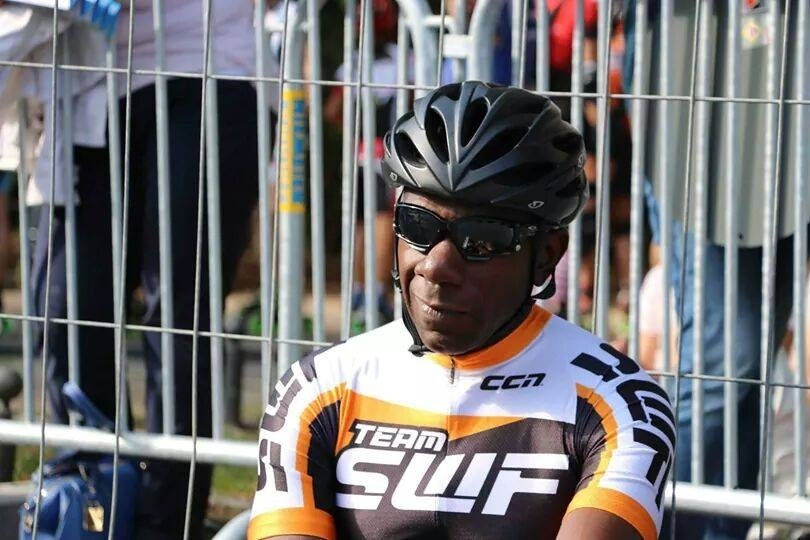
Errol Spence was interviewed on 14th June 2025. You can watch his interview here.
#69 in the list of senior British men to have represented GB (1993)